
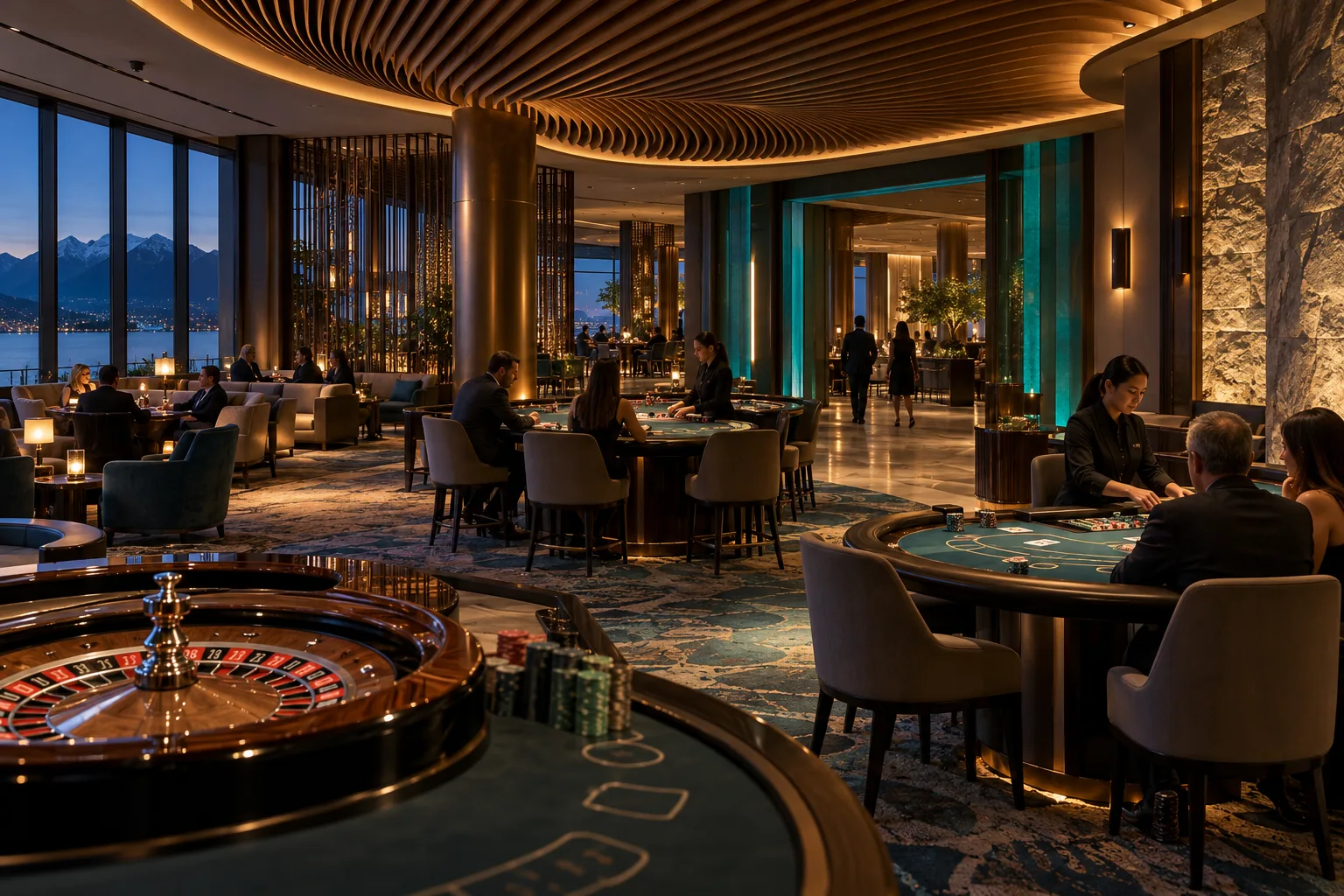
Guests read signs, dealers handle cards and chips, and cameras record the table; each task puts different demands on casino lighting. Research on dim rooms and simulated casino décor measures different outcomes. A useful brief separates visual performance and atmosphere from claims about player behaviour.
Begin with the visual task
At an entrance, a guest needs to find the next destination. At a table, the dealer handles cards and chips; at a cashier's counter, staff check money and documents. Steps, menus and service points create still other viewing tasks. Their surfaces, distances and viewing directions vary, so the lighting brief needs more detail than a room-wide instruction to make the floor bright or dim.
The Illuminating Engineering Society's RP-9-23 hospitality guidance covers casinos and gaming. It identifies tables, cashier cages and bars as spaces with particular lighting needs, and calls out light levels, veiling reflections and colour rendition. It is recommended practice, not a Canadian building regulation; local code and approval requirements still apply.
A brief should name the task before the fixture
- what a guest has to read or recognize
- where a dealer or cashier needs accurate visual detail
- which routes and level changes must remain legible
- what a camera must capture without reflections obscuring the view
- which surfaces will receive light and which should stay visually quiet
Use the right measurement for the question
Illuminance describes light reaching a surface and is measured in lux. Luminance describes light leaving a surface or display in a direction. These values are not interchangeable. Colour rendition, contrast and glare are separate design checks.
Assign each layer a job
A well-coordinated room may combine general illumination, light directed toward a task, accent lighting on architectural features and light generated by machines or digital displays. These layers can overlap, but the specification should say what each one is doing. General illumination establishes the field in which people move; task light supports a surface; an accent can distinguish a threshold or destination; the display emits its own moving image and brightness.
| Zone | Visual task | Design check |
|---|---|---|
| Table game | Read cards, chips and markings across a shared surface | Evenness on the table, facial visibility and reflections from polished surfaces |
| Slot area | See game content while recognizing nearby circulation | Display brightness against surrounding light and views of adjacent routes |
| Cashier or service desk | Read information and complete transactions | Clear view of documents, faces and counter edges |
| Main route | Find a destination and detect changes in level | Continuity, sign contrast and clear transition between zones |
| Bar or lounge | Read menus, see people and use a lower-stimulation seating area | Local task lighting without spilling glare into adjacent uses |
Use these tasks to brief the lighting designer. Set target levels against the standards that apply locally, then check the installed scheme with actual finishes, displays and furniture. A bare-plan calculation misses reflections from glass, stone, metal and screens.
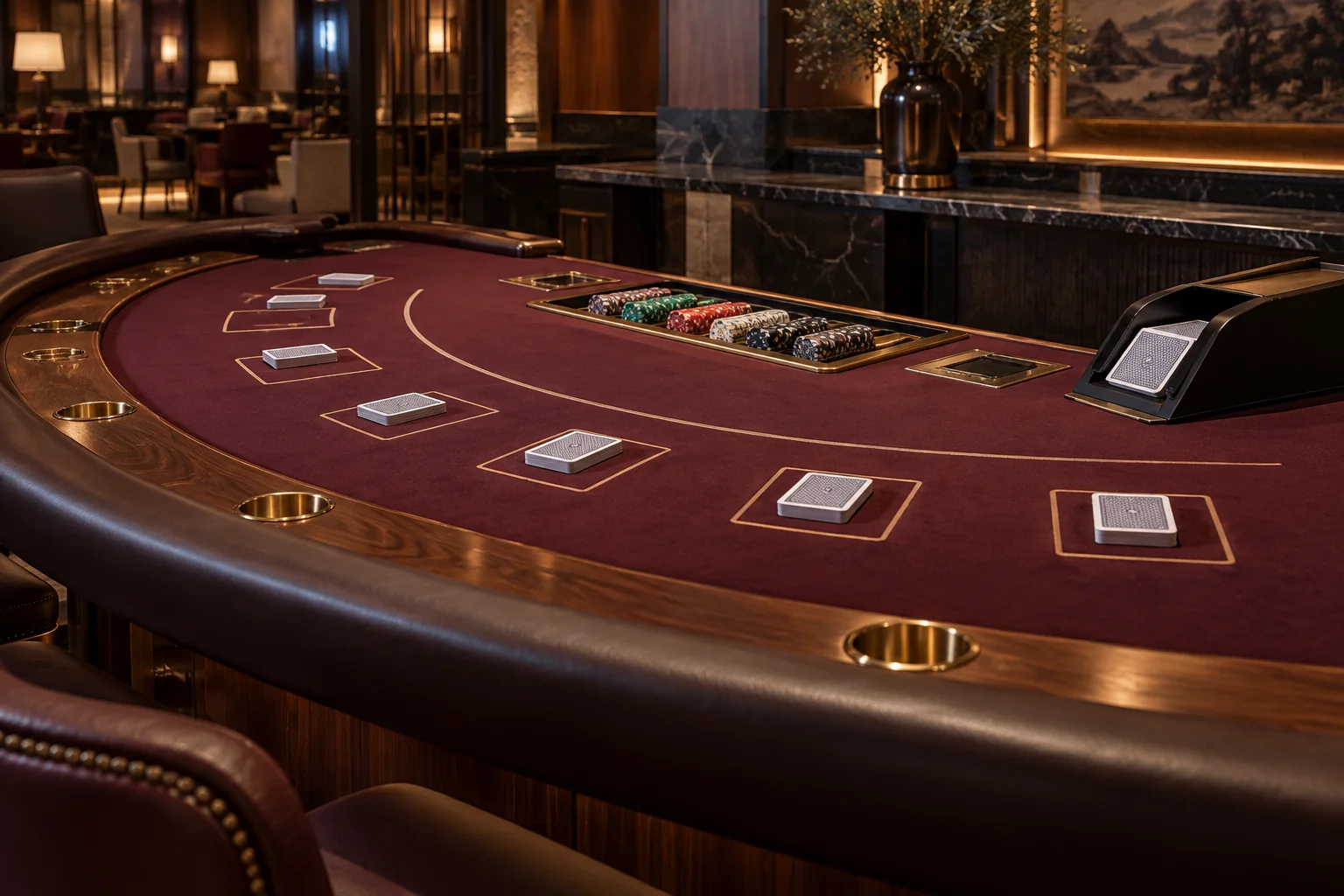
Use contrast to mark a change in place
A brighter portal, wall wash or ceiling-colour shift can mark a transition. The cue should read from the approach without obscuring a sign or route. Essential wayfinding still needs clear signs and consistent destination names.
Montréal uses colour as a floor identity
The Casino de Montréal occupies the former France Pavilion from Expo 67. Provencher_Roy's modernization account describes playing-card-suit colours on the four gaming floors, expressed through perforated aluminium panels, plus oversized tokens and card-figure sculptures near relaxation areas. These features make the zones visually distinct; the project account reports no test of their effect on player decisions.
Surface colour and light colour are different. A project description should say whether a cue comes from a finish, luminaire, projection or display. If it is intended for wayfinding, check that a visitor can distinguish the zone and find its destination; colour alone may not explain the room's purpose.
What dim-light experiments found
Jasmina Ilicic and Stacey Baxter tested ambient lighting in three experimental studies published in the Journal of Gambling Studies. Each recruited undergraduate students at an Australian university: 105 in the first study, 130 in the second and 140 in the third. Across the experiments, the researchers reported longer play and higher total spend in dim rather than bright ambient-light conditions. Their process evidence linked the effect to risk-taking; in a later study, creating a more open space to heighten self-awareness reduced the risk-taking response and the subsequent effects on play and spend.
The experiments involved Australian university students, not a representative sample of Canadian casino patrons. Their results cannot set an effect size for a particular venue or a Canadian legal minimum.
What the experiment can support
The laboratory work compared dim and bright ambient light and proposed a risk-taking mechanism. It did not measure conditions on a casino floor or test whether brighter light reduces gambling harm. Venue teams need local measurements; regulators need separate evidence before setting a minimum.
Separate lighting from the rest of the atmosphere
A University of Guelph research team led by Karen Finlay examined simulated casino décor with 484 gamblers. Participants watched video simulations that varied between two broad casino layouts and changed individual décor features, including static versus flashing light, colour, crowding, machine grouping and symmetry. They rated at-risk gambling intention, pleasure and restoration. The researchers found that effects of information load were complex and depended on the larger design and participant characteristics.
The study measured ratings after video simulations, not money spent or play length in an operating venue. It cannot show that flashing fixtures alone cause excessive gambling. It does show why lighting should be interpreted within the larger layout and its other cues.
Measure the individual cue and the combined scene
Light interacts with colour, sound, people, equipment and room geometry. For a dimming pilot, keep the task and operating period comparable. Measure glare for a comfort question; define session duration and exposure for a behaviour question. Mood, intention and recorded play length are different outcomes.
Account for the light coming from game screens
A slot terminal emits changing light. In a proof-of-concept study, 53 experienced gamblers played a commercial machine for 20 minutes while wearing mobile eye trackers. Researchers observed pupil dilation after bonus features, then showed in a separate test that screen-brightness changes could trigger pupil responses. Luminance therefore complicates any claim that pupil dilation measures excitement.
Ambient room light and a display's changing image are separate exposures. A low-lit room does not describe screen luminance or a player's eye response. In arousal research, measure or control luminance so that a brightness reflex is not mistaken for emotion.
For a terminal mock-up or field measurement, record
- ambient illuminance at the player's position
- screen luminance during representative game states
- reflections visible from seated and standing views
- the distance and angle between the player and display
- the timing of visual changes relative to sound and game events
Display contrast across lighting scenes
Evaluate a dimming scene with active displays. Check instructions, denominations and service information in both brighter and darker game states. This tests visibility, not behaviour.
Commission the lighting as an operating system
A lighting plan changes after installation as fixtures age, screens are replaced and furniture or operating scenes move. The IES standards library includes guidance on controls, commissioning and colour rendition, and its hospitality recommendations include gaming spaces. These references support a specification but do not replace Canadian provincial or municipal requirements.
A room-by-room commissioning record
- Name the room, visual task, applicable Canadian code and adopted lighting reference
- Measure representative table, counter, route and display conditions with furnishings in place
- Check glare, reflection, facial visibility, sign legibility and colour appearance from actual viewpoints
- Record control scenes, dimming ranges, event settings and who can change them
- Repeat the measurements after a screen, finish, fixture or operating scene changes
A lighting measurement is interpretable only with its meter, location, control scene and time of day. Keep those conditions with the observation. A finding about legibility at a cashier counter cannot be presented as evidence that the same scene changed gambling behaviour.